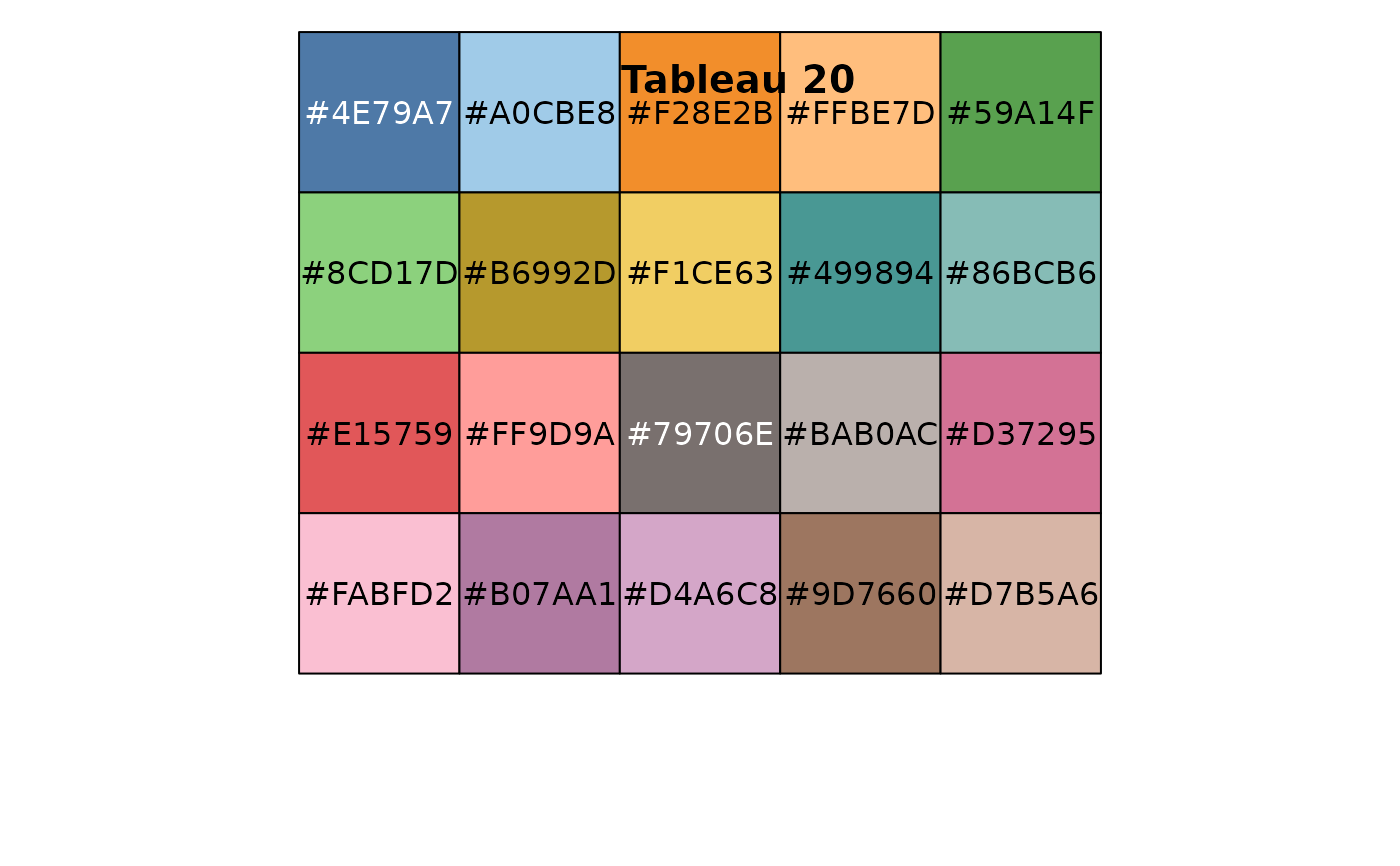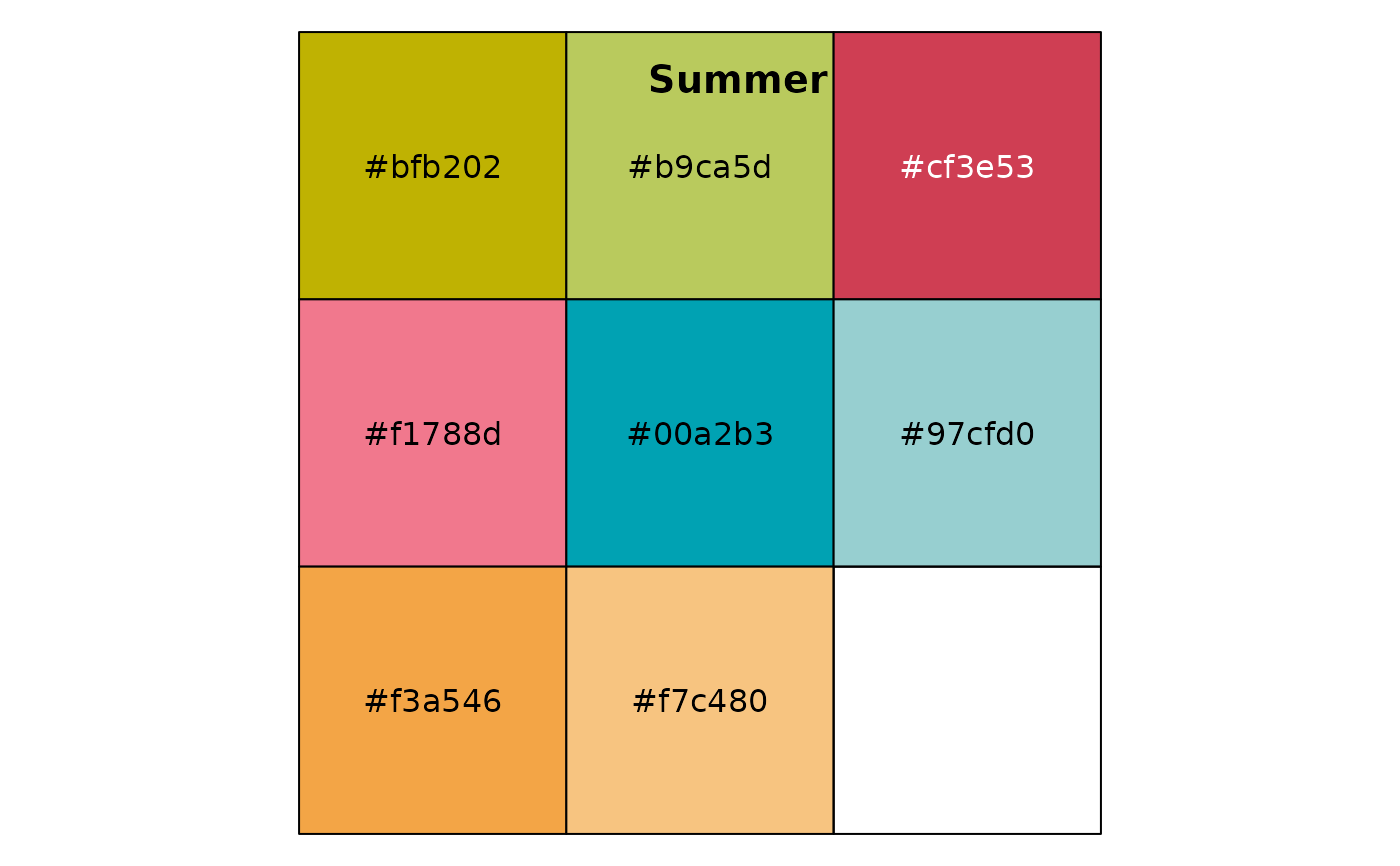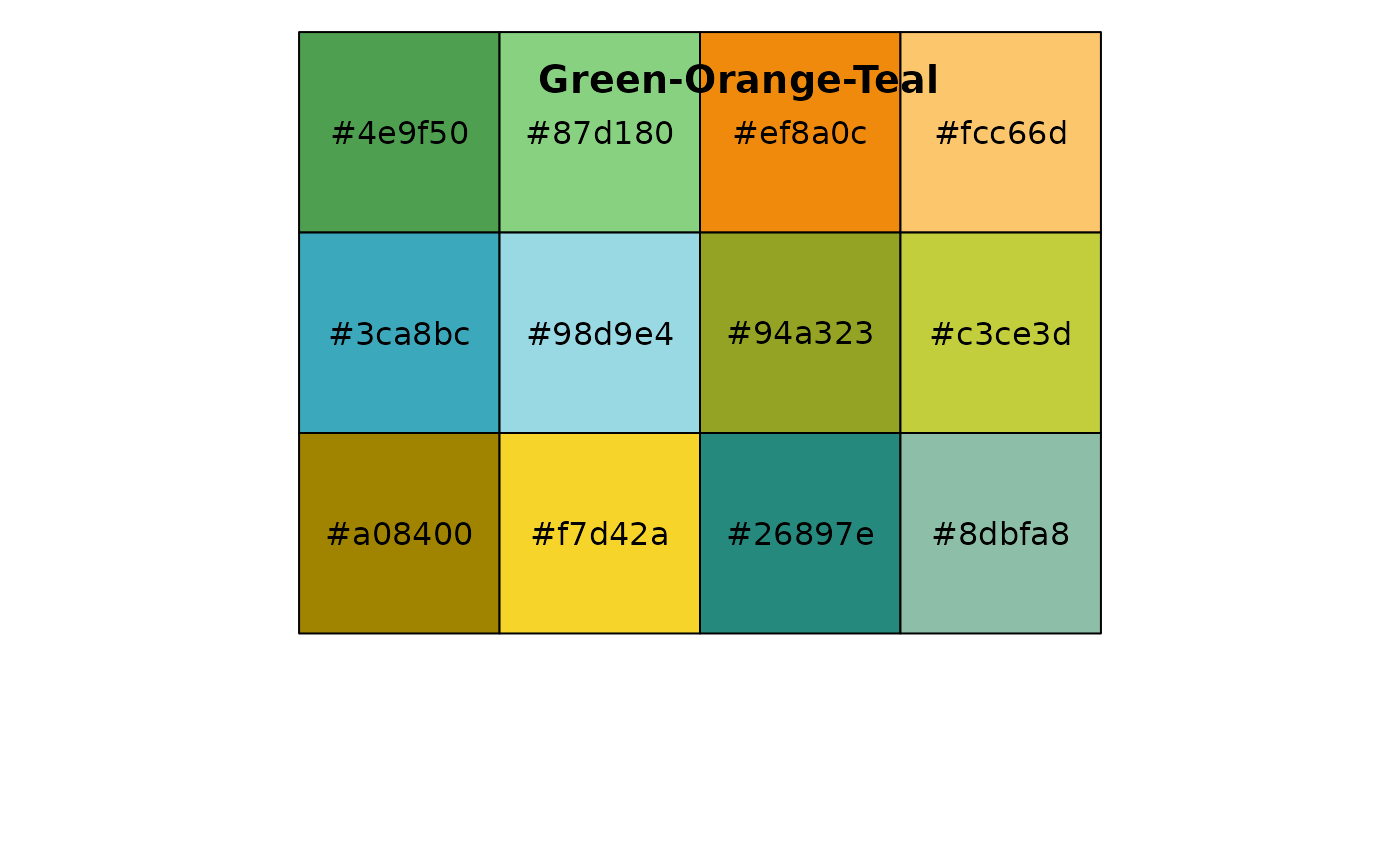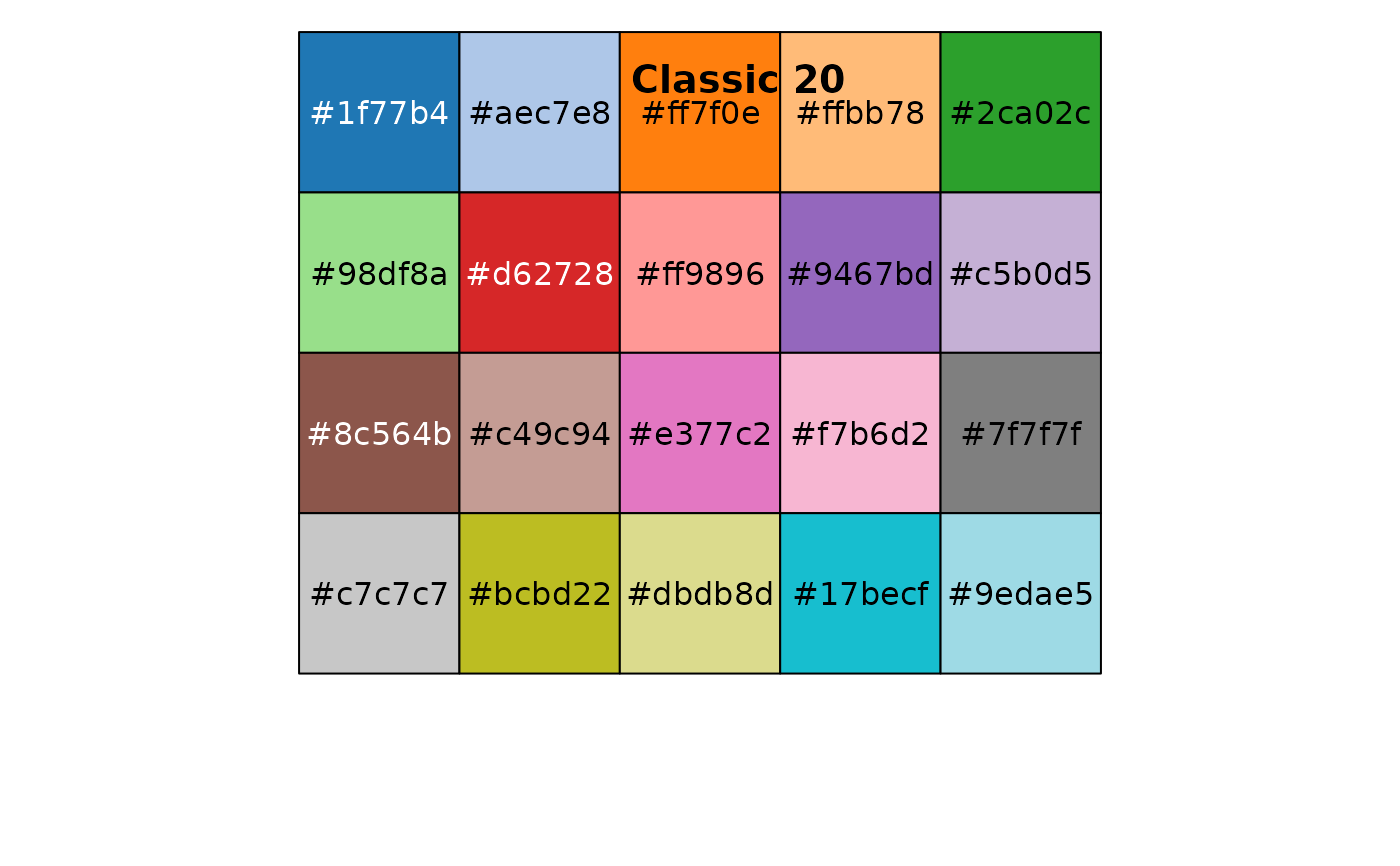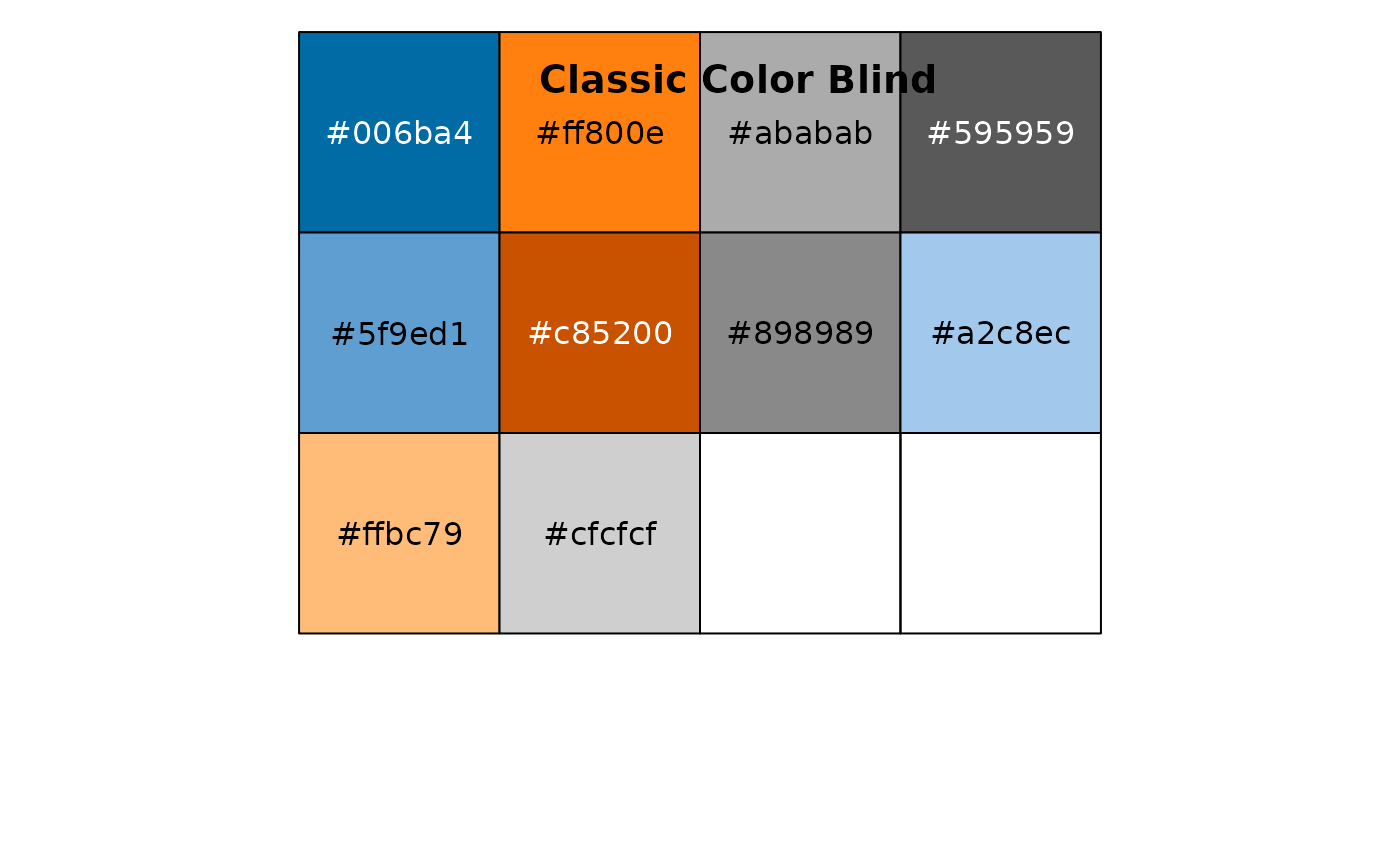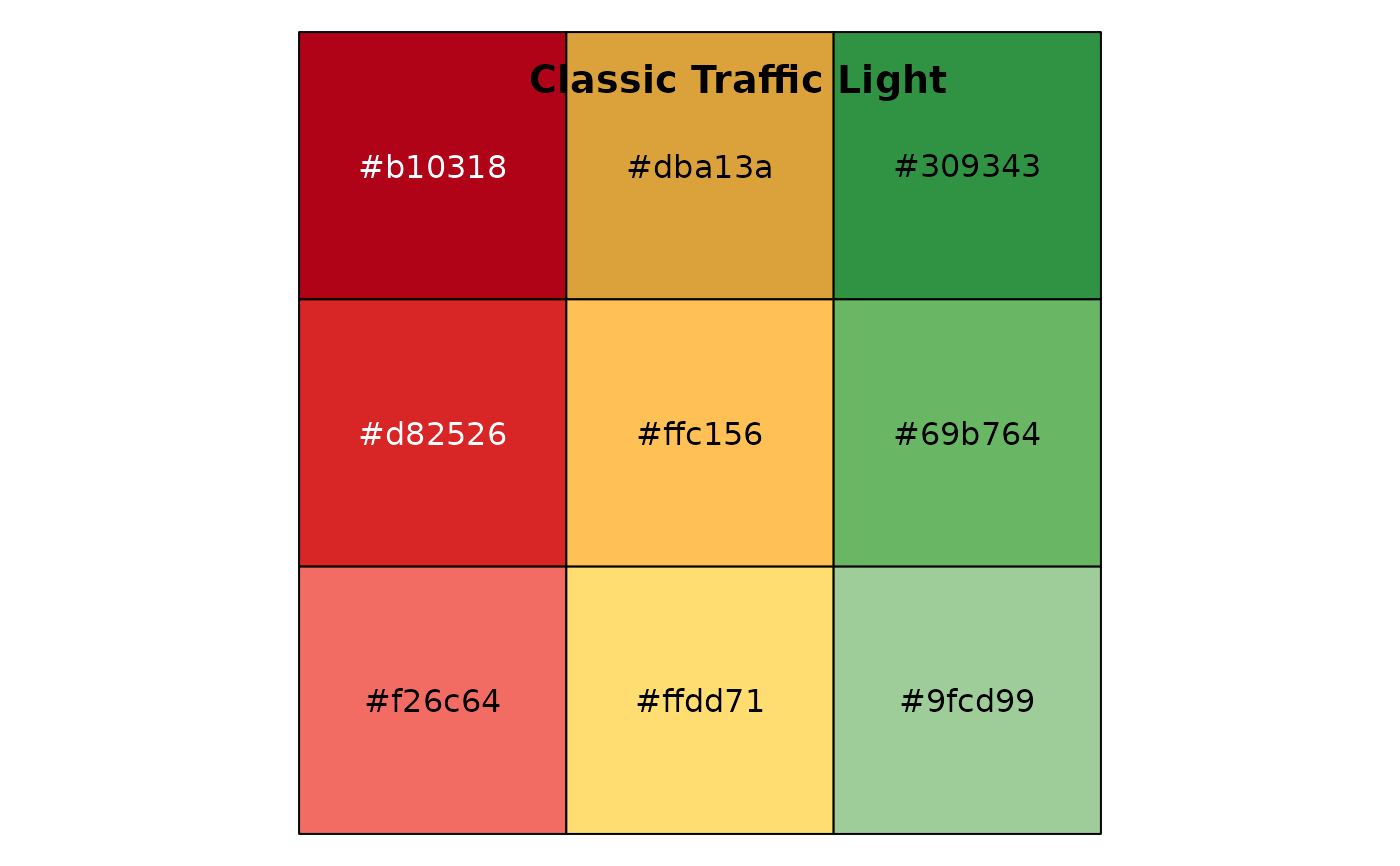
Color palettes used in Tableau.
Arguments
- palette
A string, the palette name. See Details for available palettes.
- type
The type of palette, one of:
"regular", the default: discrete, qualitative palettes."ordered-sequential": sequential palettes."ordered-diverging": diverging palettes.
- direction
If
1(the default), use the original order of colors. If-1, reverse the order.
Value
A palette function. It takes the number of colors n and returns a character vector of n
hex colors, and can be used as the palette argument of ggplot2::discrete_scale().
Details
Tableau provides three types of color palettes:
"regular" (discrete, qualitative categories),
"ordered-sequential", and "ordered-diverging".
"regular":"Tableau 10","Tableau 20","Color Blind","Seattle Grays","Traffic","Miller Stone","Superfishel Stone","Nuriel Stone","Jewel Bright","Summer","Winter","Green-Orange-Teal","Blue-Red-Brown","Purple-Pink-Gray","Hue Circle","Classic 10","Classic 10 Medium","Classic 10 Light","Classic 20","Classic Gray 5","Classic Color Blind","Classic Traffic Light","Classic Purple-Gray 6","Classic Purple-Gray 12","Classic Green-Orange 6","Classic Green-Orange 12","Classic Blue-Red 6","Classic Blue-Red 12","Classic Cyclic"."ordered-diverging":"Orange-Blue Diverging","Red-Green Diverging","Green-Blue Diverging","Red-Blue Diverging","Red-Black Diverging","Gold-Purple Diverging","Red-Green-Gold Diverging","Sunset-Sunrise Diverging","Orange-Blue-White Diverging","Red-Green-White Diverging","Green-Blue-White Diverging","Red-Blue-White Diverging","Red-Black-White Diverging","Orange-Blue Light Diverging","Temperature Diverging","Classic Red-Green","Classic Red-Blue","Classic Red-Black","Classic Area Red-Green","Classic Orange-Blue","Classic Green-Blue","Classic Red-White-Green","Classic Red-White-Black","Classic Orange-White-Blue","Classic Red-White-Black Light","Classic Orange-White-Blue Light","Classic Red-White-Green Light","Classic Red-Green Light"."ordered-sequential":"Blue-Green Sequential","Blue Light","Orange Light","Blue","Orange","Green","Red","Purple","Brown","Gray","Gray Warm","Blue-Teal","Orange-Gold","Green-Gold","Red-Gold","Classic Green","Classic Gray","Classic Blue","Classic Red","Classic Orange","Classic Area Red","Classic Area Green","Classic Area Brown".
References
http://vis.stanford.edu/color-names/analyzer/
Maureen Stone, 'Designing Colors for Data' (slides), at the International Symposium on Computational Aesthetics in Graphics, Visualization, and Imaging, Banff, AB, Canada, June 22, 2007.
Heer, Jeffrey and Maureen Stone, 2012 'Color Naming Models for Color Selection, Image Editing and Palette Design', ACM Human Factors in Computing Systems (CHI) http://vis.stanford.edu/files/2012-ColorNameModels-CHI.pdf.
See also
Other color tableau:
scale_colour_gradient2_tableau(),
scale_colour_gradient_tableau(),
scale_colour_tableau(),
tableau_gradient_pal()