Edward Tufte's revisions of the box plot as described in The Visual Display of Quantitative Information. This function provides several box plot variants:
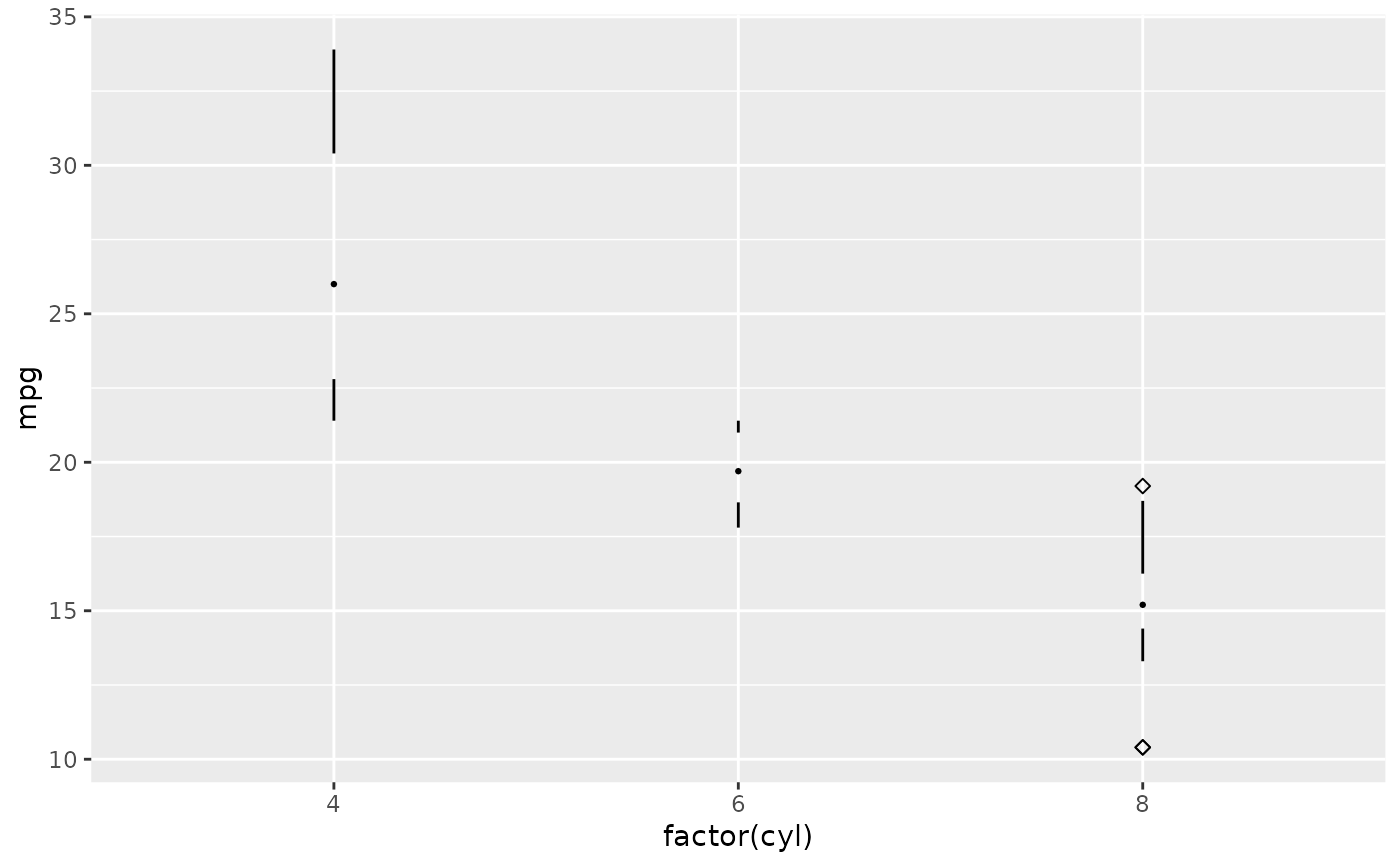
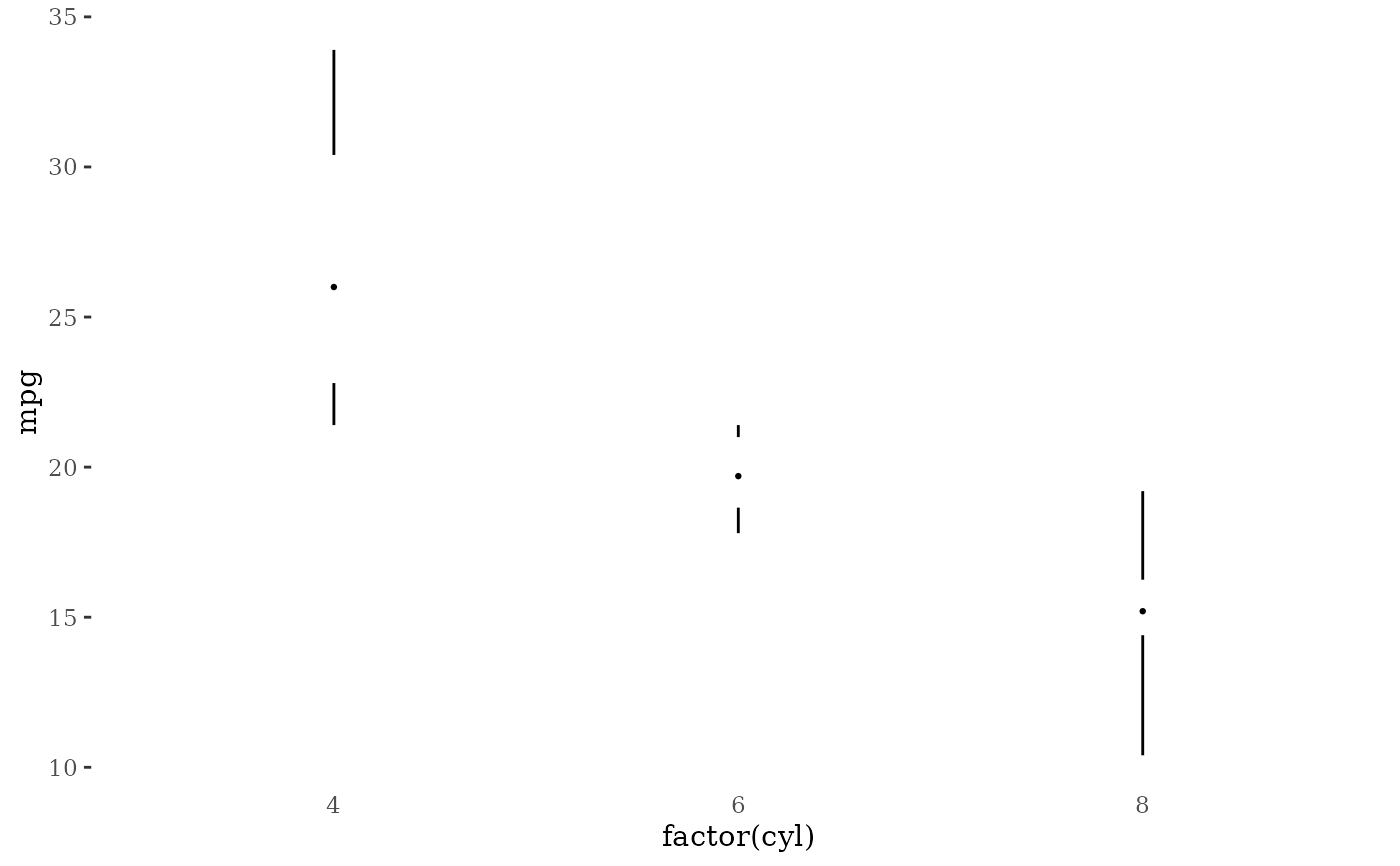
A point indicating the median, a gap indicating the interquartile range, and lines for whiskers.
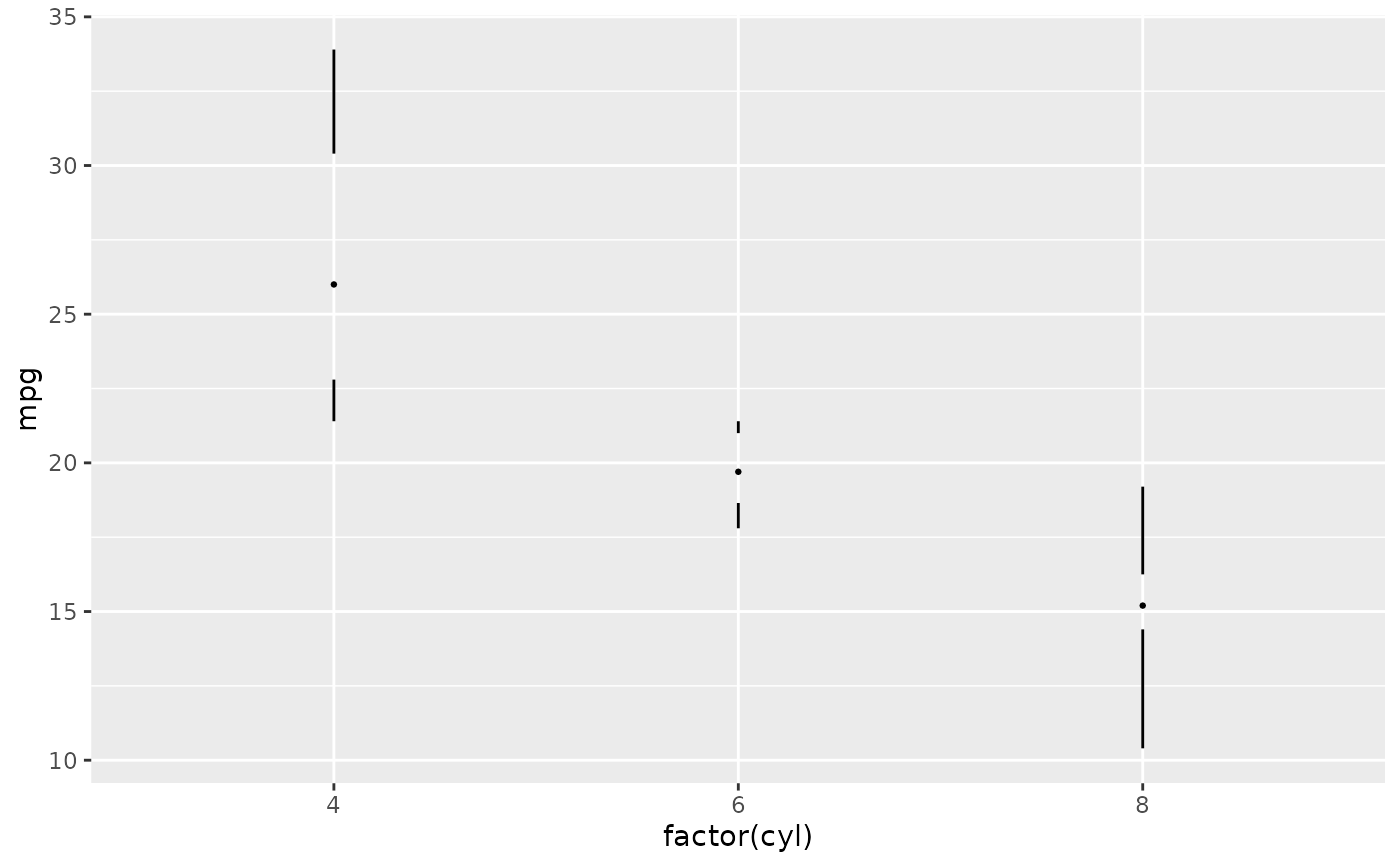
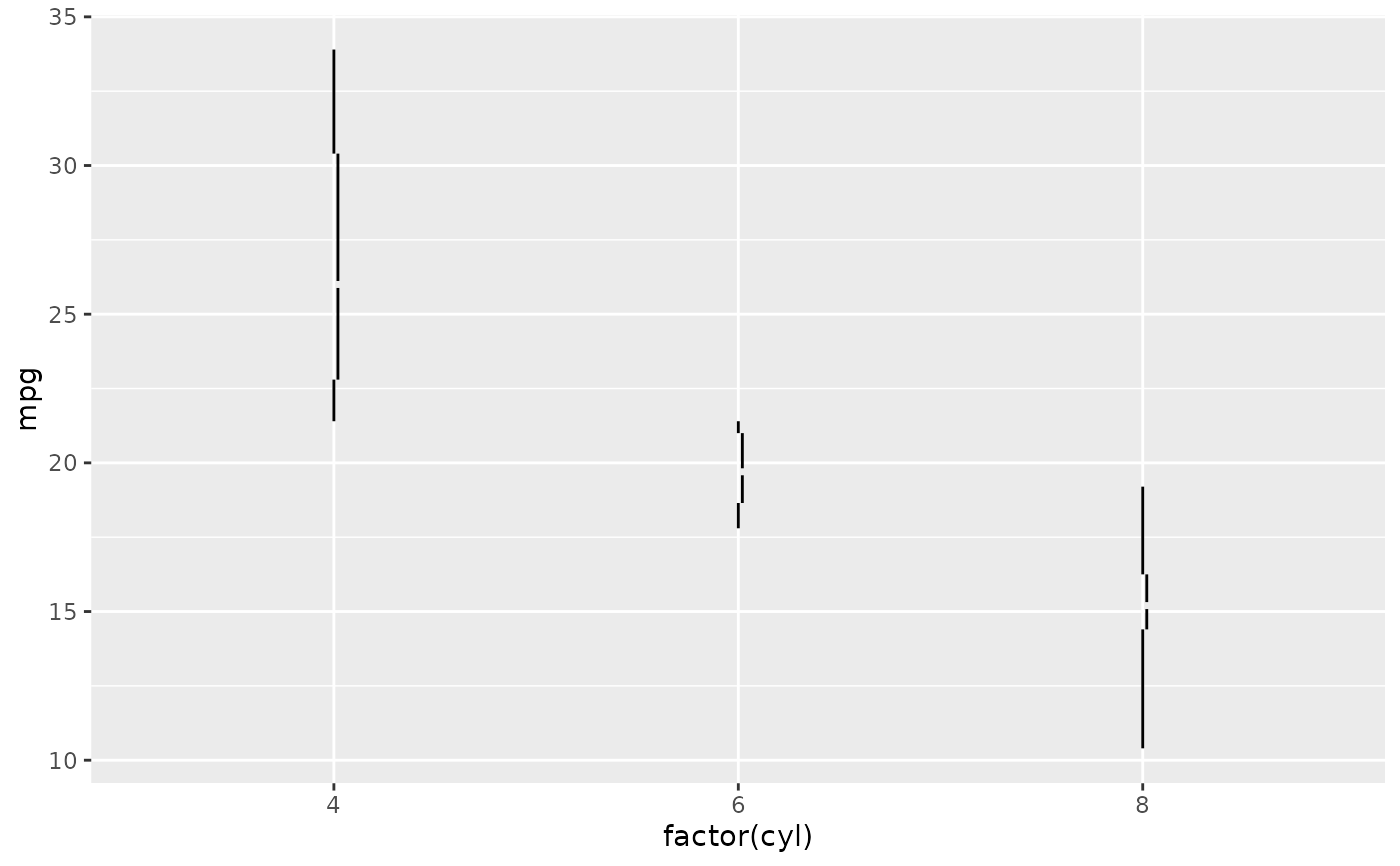
An offset line indicating the interquartile range and a gap indicating the median.
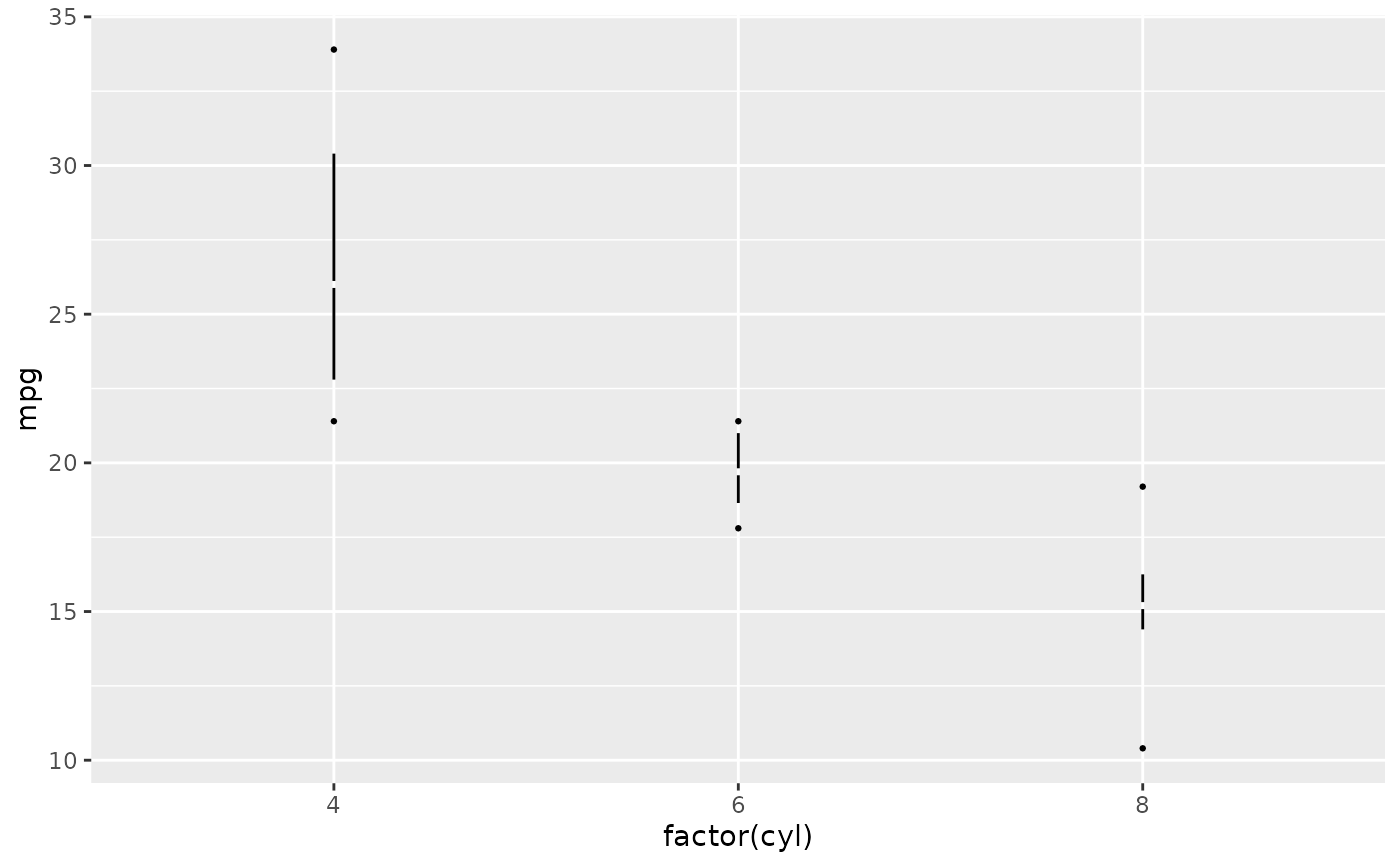
A line indicating the interquartile range, a gap indicating the median, and points indicating the minimum and maximum values.
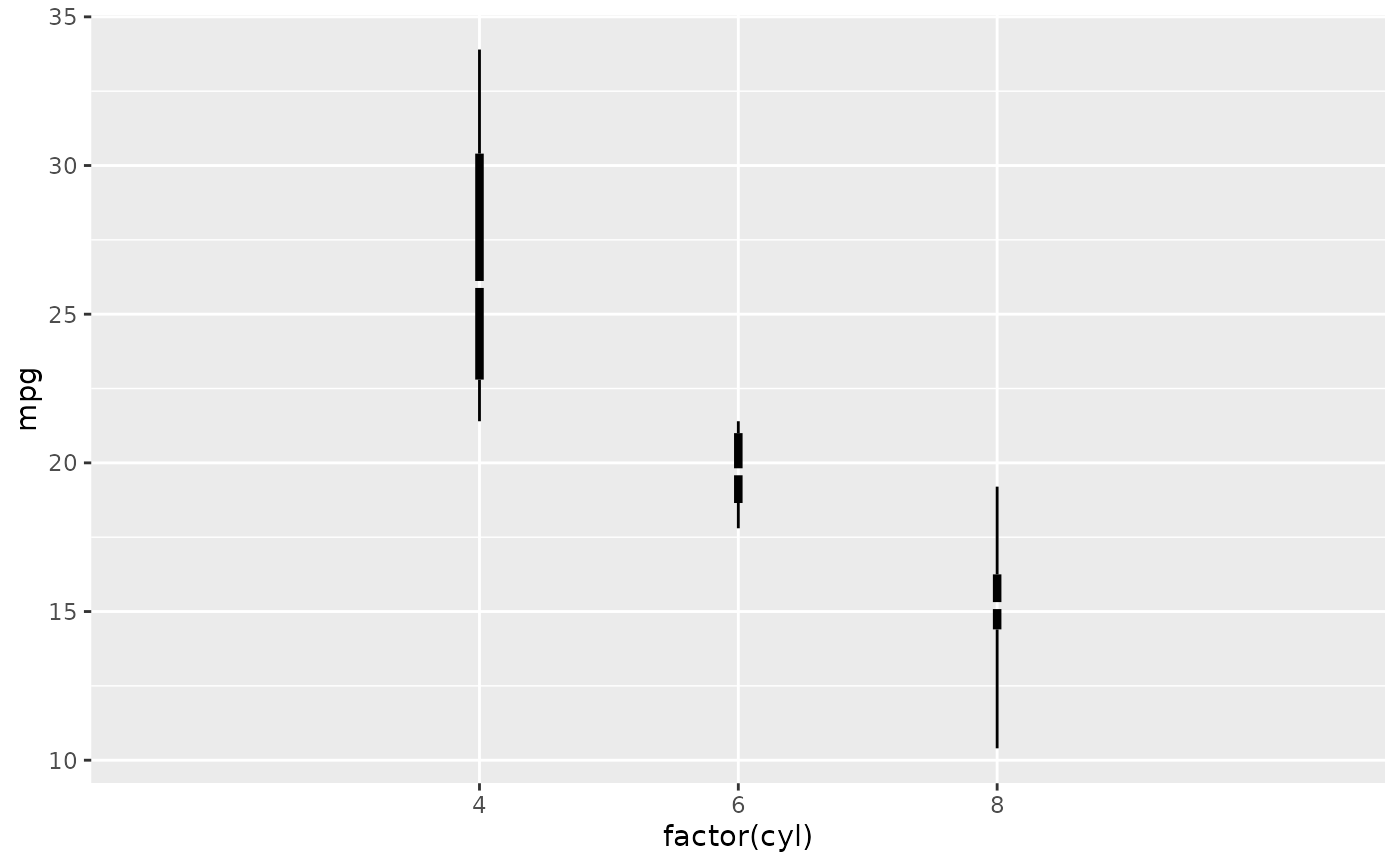
A wide line indicating the interquartile range, a gap indicating the median, and lines indicating the minimum and maximum.
Usage
geom_tufteboxplot(
  mapping = NULL,
  data = NULL,
  stat = "fivenumber",
  position = "dodge",
  outlier.colour = "black",
  outlier.shape = 19,
  outlier.size = 1.5,
  outlier.stroke = 0.5,
  voffset = 0.01,
  hoffset = 0.005,
  na.rm = FALSE,
  show.legend = NA,
  inherit.aes = TRUE,
  median.type = "point",
  whisker.type = "line",
  ...
)
Arguments
- mapping
Set of aesthetic mappings created by
aes(). If specified andinherit.aes = TRUE(the default), it is combined with the default mapping at the top level of the plot. You must supplymappingif there is no plot mapping.- data
The data to be displayed in this layer. There are three options:
If
NULL, the default, the data is inherited from the plot data as specified in the call toggplot().A
data.frame, or other object, will override the plot data. All objects will be fortified to produce a data frame. Seefortify()for which variables will be created.A
functionwill be called with a single argument, the plot data. The return value must be adata.frame, and will be used as the layer data. Afunctioncan be created from aformula(e.g.~ head(.x, 10)).- stat
The statistical transformation to use on the data for this layer, as a string. The default (
stat = 'fivenumber') callsstat_fivenumber()and produces whiskers that extend from the interquartile range to the extremes of the data; specifyingggplot2::stat_boxplot()will produce a more traditional boxplot with whiskers extending to the most extreme points that are < 1.5 IQR away from the hinges (i.e., the first and third quartiles).- position
A position adjustment to use on the data for this layer. This can be used in various ways, including to prevent overplotting and improving the display. The
positionargument accepts the following:The result of calling a position function, such as
position_jitter(). This method allows for passing extra arguments to the position.A string naming the position adjustment. To give the position as a string, strip the function name of the
position_prefix. For example, to useposition_jitter(), give the position as"jitter".For more information and other ways to specify the position, see the layer position documentation.
- outlier.colour
Color of outlying points.
- outlier.shape
Shape of outlying points.
- outlier.size
Size of outlying points.
- outlier.stroke
Stroke width of outlying points.
- voffset
Controls the size of the gap in the line representing the median when
median.type = "line". This is a fraction of the range ofy.- hoffset
Controls how much the interquartile line is offset from the whiskers when
median.type = "line". This is a fraction of the range ofx.- na.rm
If
FALSE, the default, missing values are removed with a warning. IfTRUE, missing values are silently removed.- show.legend
logical. Should this layer be included in the legends?
NA, the default, includes if any aesthetics are mapped.FALSEnever includes, andTRUEalways includes. It can also be a named logical vector to finely select the aesthetics to display. To include legend keys for all levels, even when no data exists, useTRUE. IfNA, all levels are shown in legend, but unobserved levels are omitted.- inherit.aes
If
FALSE, overrides the default aesthetics, rather than combining with them. This is most useful for helper functions that define both data and aesthetics and shouldn't inherit behaviour from the default plot specification, e.g.annotation_borders().- median.type
How to represent the median, one of:
"point", the default: the median is a point, and the interquartile range is a gap in the line."line": the interquartile range is a line, possibly offset, and the median is a gap in the line.
- whisker.type
How to represent the whiskers, one of:
"line", the default: whiskers are lines."point": whiskers are points atyminandymax.
- ...
Other arguments passed on to
layer()'sparamsargument. These arguments broadly fall into one of 4 categories below. Notably, further arguments to thepositionargument, or aesthetics that are required can not be passed through.... Unknown arguments that are not part of the 4 categories below are ignored.Static aesthetics that are not mapped to a scale, but are at a fixed value and apply to the layer as a whole. For example,
colour = "red"orlinewidth = 3. The geom's documentation has an Aesthetics section that lists the available options. The 'required' aesthetics cannot be passed on to theparams. Please note that while passing unmapped aesthetics as vectors is technically possible, the order and required length is not guaranteed to be parallel to the input data.When constructing a layer using a
stat_*()function, the...argument can be used to pass on parameters to thegeompart of the layer. An example of this isstat_density(geom = "area", outline.type = "both"). The geom's documentation lists which parameters it can accept.Inversely, when constructing a layer using a
geom_*()function, the...argument can be used to pass on parameters to thestatpart of the layer. An example of this isgeom_area(stat = "density", adjust = 0.5). The stat's documentation lists which parameters it can accept.The
key_glyphargument oflayer()may also be passed on through.... This can be one of the functions described as key glyphs, to change the display of the layer in the legend.
References
Tufte, Edward R. (2001) The Visual Display of Quantitative Information, Chapter 6.
McGill, R., Tukey, J. W. and Larsen, W. A. (1978) Variations of box plots. The American Statistician 32, 12-16.
See also
Other geom tufte:
geom_rangeframe()
Other tufte:
extended_range_breaks_(),
geom_rangeframe(),
theme_tufte()
Examples
library("ggplot2")
p <- ggplot(mtcars, aes(factor(cyl), mpg))
# with a point for the median and lines for whiskers
p + geom_tufteboxplot()
 # with a line for the interquartile range and points for whiskers
p + geom_tufteboxplot(median.type = "line", whisker.type = "point", hoffset = 0)
# with a line for the interquartile range and points for whiskers
p + geom_tufteboxplot(median.type = "line", whisker.type = "point", hoffset = 0)
 # with a wide line for the interquartile range and lines for whiskers.
# `width` scales the median line but is also the box width, so use
# position = "identity" to stop position_dodge() warning about overlaps.
p + geom_tufteboxplot(median.type = "line", hoffset = 0, width = 3, position = "identity")
# with a wide line for the interquartile range and lines for whiskers.
# `width` scales the median line but is also the box width, so use
# position = "identity" to stop position_dodge() warning about overlaps.
p + geom_tufteboxplot(median.type = "line", hoffset = 0, width = 3, position = "identity")
 # with an offset line for the interquartile range and lines for whiskers
p + geom_tufteboxplot(median.type = "line")
# with an offset line for the interquartile range and lines for whiskers
p + geom_tufteboxplot(median.type = "line")
 # combined with theme_tufte
p + geom_tufteboxplot() + theme_tufte() + theme(axis.ticks.x = element_blank())
# combined with theme_tufte
p + geom_tufteboxplot() + theme_tufte() + theme(axis.ticks.x = element_blank())
 # traditional boxplot with whiskers only out to 1.5 IQR, outlier points
p + geom_tufteboxplot(stat = "boxplot", outlier.shape = 5)
# traditional boxplot with whiskers only out to 1.5 IQR, outlier points
p + geom_tufteboxplot(stat = "boxplot", outlier.shape = 5)